Product Description
Product FeaturesNote1
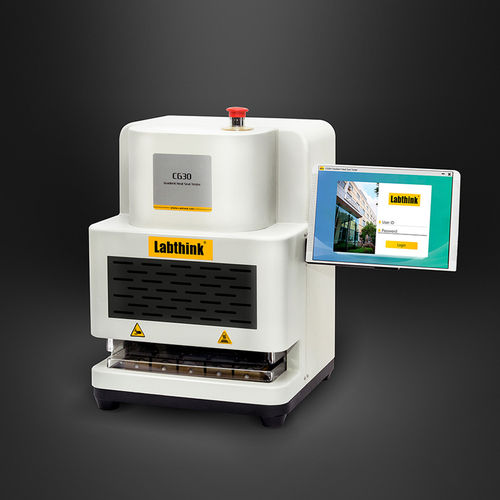
- Ten (upper and lower) sealing jaws with metal surfaces to obtain heat sealing parameters that are close to actual parameters
- Digital P.I.D. temperature control technology ensures the preset temperature to be reached rapidly without fluctuations
- Auto constant pressure technology guarantees the stable sealing pressure, requiring no manual adjustment
- Auto leveling technology of sealing jaws ensures uniform sealing performance
- Wide range control of temperature, pressure and time that meet various test conditions
- Manual or pedal switch, as well as anti-scald design provides convenient and safe operating environment
- Professional software supports remote operation for convenient data saving, exporting and printing
Excellent User-oriented, High-efficient and Safe Designs
- The instrument can complete 5 groups of specimen tests at a time, helps the user to obtain heat sealing parameters of the specimens accurately and efficiently.
- The temperature of upper sealing jaws and lower sealing jaws can be controlled separately, which can meet the requirements for different combination of temperatures
- Separated type sealing jaws can be easily replaced
- Manual and pedal switch mode for starting test as well as the anti-scald design ensures the safe operation
High-end and Easy-to-Use Embedded Computer-controlled System
- The instrument is equipped with large size tablet (touch screen), which is easy to operate and observe during the test process
- Brand new software simplifies the testing process.
- The system supports comparison analysis of groups of test data with unit conversion function
- USB ports and internet interface for connecting of external device and data transmission
- The instrument conforms to the requirements of GMP (optional)
- Labthinkis unique data security system separates the test data from the computer to avoid the risks caused by computer virus
- Labthinkis unique DataShiledTMSystem for data management and connecting with information system (optional)
Test StandardNote1
ASTM F2029, QB/T 2358, YBB 00122003
Applications
| Basic Applications |
- Films with Smooth Surface
Including plastic films, plastic composite films, paper-plastic composite films, coextruded films, aluminized films, aluminum foils, aluminum foil composite films and many others. Heat sealing surface should be smooth and width can be designed based on user requirements.
|
- Films with Decorative Pattern Surface
Including plastic films, plastic composite films, paper-plastic composite films, coextruded films, aluminized films, aluminum foil, aluminum foil composite films and many others. Heat sealing surface can be designed based on user requirements.
|
| Extended Applications |
- Plastic Flexible Tubes
The ends of plastic flexible tubes are placed in between upper and lower jaws and then sealed to form a package.
|
Technical SpecificationsNote2
| Specifications |
C630H Heat Seal Tester |
| Sealing Temperature |
Room temperature 300C |
| Sealing Pressure |
0.1Mpa 0.7 Mpa (14psi 101psi) |
| Resolution of Pressure |
0.001 MPa |
| Dwell Time |
0.1 999.99 s |
| Resolution of Time |
0.01 s |
| Resolution of Temperature |
0.1C |
| Temperature Fluctuation |
i0.2C |
| Temperature Accuracy |
i0.5C (single point calibration) |
| Temperature Gradient |
i20C |
| Gas Supply Pressure |
0.7 Mpa (101psi) |
| Port Size |
i8 mm PU Tubing |
| Sealing Area |
40 mm i 10 mm |
| Number of Sealing Jaws |
5 groups of upper and lower sealing jaws with independent temperature control |
| Instrument Dimension |
375mm (L) i 360 mm (W) i 518mm (H) |
| Power Supply |
220VAC 50Hz / 120VAC 60Hz |
| Net Weight |
55 kg |
Configurations
- Standard Configurations
- Instrument, Tablet, Pedal Switch, High-temperature Welding Cloth, Sample Cutter, i8mm PU Tubing (2m)
- Optional Parts
- High-temperature Welding Cloth, Air Compressor, GMP System, DataShieldTMNote3
- Note
- 1. The gas supply port of the instrument is i8 mm PU Tubing;
2. Customers need to prepare gas supply.
Note 1:The described test standard, applications and product features should be in line with Technical Specifications.
Note 2:The parameters in the table are measured by professional operators in Labthink laboratory under strictly controlled laboratory conditions.
Note 3:DataShieldTMprovides safe and reliable data application support. Multiple Labthink instruments can share one single DataShieldTMsystem which can be configured as required.
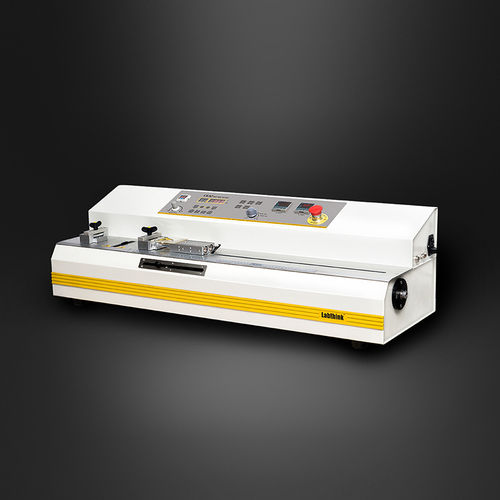
High Precision Heat Seal TestingAchieve reliable and repeatable results with microprocessor-based controls, high precision temperature (1C) and pressure management, and fast response time (0.5s). This tester's broad measuring and temperature range, along with double, independently controlled heating jaws, enable users to evaluate various film and packaging substrates under controlled conditions. The wide jaw size and adjustable seal parameters support versatile benchmarking across global testing standards.
Comprehensive Safety and User FeaturesBenefit from enhanced operator safety with over-temperature protection and a dedicated emergency stop button. The clear LCD digital display streamlines test setup, monitoring, and result visibility. Designed for semi-automatic operation in laboratory or industrial environments, this tester integrates intuitive controls and automation features while remaining robust and compact for convenient benchtop use.
Data Management and ComplianceStreamline your quality checks with USB/RS232C interfaces for efficient data download and reporting. This heat seal tester meets ASTM F2029, GB/T 2790, GB/T 2791, and related standards, facilitating easy compliance and international benchmarking for manufacturers and exporters. Data accuracy is assured with 1% F.S. measurement and high resolution (0.01 N), enabling traceable, standards-driven quality control.
FAQ's of Plastic Film Heat Seal Testers:
Q: How does the Plastic Film Heat Seal Tester ensure accurate temperature and pressure control during testing?
A: The tester uses a double heating method with independent temperature control for both upper and lower jaws, achieving high precision (1C) and ensuring uniform heat distribution across the sealing area. Pneumatic pressure control allows the operator to adjust seal pressure between 0.05 and 0.7 MPa, monitored and regulated by a microprocessor-based control system.
Q: What types of films can this Heat Seal Tester be used for?
A: It is designed for a variety of plastic films, laminated films, and packaging substrates. The adjustable test stroke, temperature, and pressure ranges make it suitable for assessing the sealing strength of different materials in quality control or research settings.
Q: When should calibration or maintenance be performed on the Heat Seal Tester?
A: Routine calibration is recommended according to your laboratory's quality standards, or after any major usage cycle. Regular maintenance should include checking the pneumatic system, jaw surfaces, and electronic controls, ensuring optimal operation and compliance with applicable standards.
Q: Where can the test data be exported from the Heat Seal Tester?
A: Testing data can be downloaded through USB or RS232C ports, allowing easy transfer to a computer or data management system for reporting, analysis, and archival. This simplifies compliance documentation and quality assurance reviews.
Q: What is the typical process of conducting a heat seal test with this equipment?
A: Prepare a specimen sized 10 mm x 150 mm, set desired sealing parameters (temperature, pressure, and time), and place the sample between the heated jaws. The microprocessor initiates the seal, applies pressure for the specified duration, and the result is displayed digitally for recording and export.
Q: How does the tester enhance laboratory or industrial quality control processes?
A: With its fast response, high accuracy, and compliance with international standards, the tester allows quality control personnel to detect seal defects and optimize packaging processes, reducing the risk of packaging failure and ensuring product integrity during distribution.
Q: What are the key benefits of using this Plastic Film Heat Seal Tester in manufacturing or lab environments?
A: Key benefits include reliable, reproducible test results, enhanced operator safety, efficient data handling, broad parameter adjustment capabilities, and standards compliance. Its semi-automatic operation streamlines workflow, while robust construction and consistent performance support heavy laboratory or industrial use.
 English
 Spanish
 French
 German
 Italian
 Chinese (Simplified)
 Japanese
 Korean
 Arabic
 Portuguese








 Send Inquiry



