Product Description
Product FeaturesNote1
Multiple Test Modes & Intelligent Statistics of Qualified Specimens
- Negative pressure method
- Multiple test modes including standard, multi-grade vacuum and methylthionine chloride mode
- Automatic test with traditional methylthionine chloride
- Vacuum degree, test time and infiltration time can be adjusted and test parameters can be saved automatically so that the tests with same test parameters can be started quickly
- Automatic constant pressure compensation ensures that the tests can be performed under preset vacuum conditions
- Real-time display of test curves, easy to observe the test results
- Automatic statistics of qualified specimens
- Main components and parts are supplied by well-known global manufacturers, with guaranteed performance
Brand New Patented Intelligent Touch Operating System
- Industrial grade touch screen, one-button operation, simplified operating interface, remote upgrade and maintenance
- Chinese and English operating interface
- Measurement unit conversion
- Automatic data storage and power failure memory to prevent data loss
- Storage up to 1200 test records (standard mode)
- Multiple-level user management and login with password
- Micro-printer and USB ports for data transmission (optional)
- The instrument conforms to the requirements of GMP (optional)
- Labthinks unique DataShiledTM System for data management and connecting with information system (optional)
Test Principle
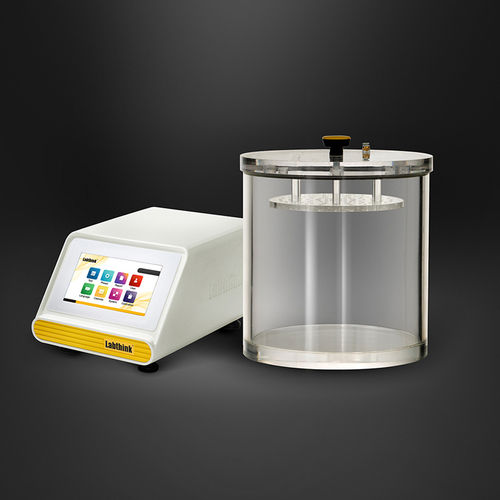
Firstly submerge the specimen in the water in the vacuum chamber, and then evacuate the vacuum chamber to form differential pressure between the inside and outside of specimen. The seal property can be obtained by observing the steady progression of bubbles from the specimen or observing how the specimen expands and restores to its original shape after vacuum release.
Test StandardNote1
ASTM D3078, GB/T 15171
Applications
| Basic Applications |
- Glass Bottles, Pipes, Cans and Boxes
|
- Plastic Bottles, Pipes, Cans and Boxes
|
- Metal Bottles, Pipes, Cans and Boxes
|
- Paper Plastic Composite Bags and Boxes
|
| Extended Applications |
|
|
|
|
|
|
Technical Specifications
| Specifications |
C660B |
| Vacuum Degree |
0 -90 KPa/ 0 -13 psi |
| Accuracy |
0.25% FS |
| Resolution |
0.1 KPa / 0.01 psi |
Vacuum Chamber
Effective Sizes |
I270 mm x 210 mm (H) (standard) |
| I360 mm x 585 mm (H) (optional) |
| I460 mm x 330 mm (H) (optional) |
| Note: customization is available for other sizes |
| Gas Supply |
Air (outside of supply scope) |
| Gas Supply Pressure |
0.5 MPa 0.7 Mpa (73psi 101psi) |
| Instrument Dimension |
334 mm (L) x 230 mm (W) x 170 mm (H) |
| Power Supply |
220VAC10% 50Hz / 120VAC10% 60Hz |
| Net Weight |
Instrument: 6.5 kg Standard Vacuum Chamber: 9kg |
Configurations
- Standard Configurations
- Instrument, Standard Vacuum Chamber (I270 mm x 210 mm), I6 PU Tubing (1m)
- Optional Parts
- Micro Printer, Professional Software, Customized Vacuum Chamber, Air Compressor, GMP System, DataShieldTM Note3
- Note
- 1. The gas supply port of the instrument isI6 mm PU Tubing;
2. Customers need to prepare gas supply.
Note 1: The described test standard, applications and product features should be in line with Technical Specifications.
Note 2: The parameters in the table are measured by professional operators in Labthink laboratory under strictly controlled laboratory conditions.
Note 3: DataShieldTM provides safe and reliable data application support. Multiple Labthink instruments can share one single DataShieldTM system which can be configured as required.
Accurate and Reliable TestingEquipped with high-precision load cells and a microcomputer control system, this instrument guarantees test accuracy within 1% of the reading. Its rapid response and high sampling rate ensure precise tensile and peel strength measurements, vital for pharmaceutical packaging applications.
Versatile for Diverse Specimen TypesDesigned for flexibility, this instrument supports a wide range of specimen sizes (customizable as needed) and accommodates various widths and thicknesses of composite sheets. Its adjustable speed and test stroke make it suitable for multiple blister pack configurations.
User-Friendly Operation and ReportingWith a digital LCD display, intuitive controls, and PC software support, users can effortlessly manage tests, store data, and generate detailed analytical reports. Dual output options (digital print and USB export) streamline documentation for regulatory compliance in quality control processes.
FAQ's of Quality Control Instrument of Solid Preparation Composite Sheets in Blister Pack:
Q: How is the tensile and peel strength test performed using this instrument?
A: The tensile and peel strength test is conducted by securing a single specimen of a blister pack composite sheet onto the instrument, setting the desired test parameters such as speed and width, and allowing the microcomputer-controlled system to apply force. The resulting strength measurement is displayed digitally, and data can be stored or exported for review.
Q: What types of specimens can be tested with this equipment?
A: The instrument is designed for solid preparation composite sheets used in pharmaceutical blister packaging. Specimen size is customizable, and the device accommodates widths between 30 and 300 mm with up to 300 mm stroke, making it suitable for a variety of packaging formats.
Q: When and where should this equipment be used?
A: This instrument is ideal for use in pharmaceutical packaging quality control labs and manufacturing facilities. It should be operated in environments with 15C-35C temperature, 20-80% relative humidity, and a stable AC 220V, 50Hz power supply.
Q: What is the test process for measuring tensile and peel strength?
A: The process involves placing a single composite sheet specimen in the gripping device, configuring the test parameters (speed, width, stroke), and initiating the test. The system automatically measures force up to 1000 N, processes the results within 2 seconds, and allows instant data output or storage.
Q: How does this equipment benefit the quality control process?
A: The instrument provides precise, repeatable results, ensures packaging reliability, minimizes human error through semi-automation, and streamlines reporting with digital data export and analysis. Its adjustable settings and high-throughput single testing enhance efficiency and compliance.
Q: What safety and maintenance requirements should users consider?
A: Users should ensure the instrument is used with the appropriate gas pressure (0.6 MPa), in a dry, clean tabletop environment, and regularly calibrated for accurate readings. Routine maintenance on the pneumatic connectors and software updates are recommended for optimal performance.
Q: Can the data be integrated with laboratory information management systems (LIMS)?
A: Yes, with RS232 and USB interfaces and PC software support, data from the instrument can be exported and integrated into LIMS or other quality management systems for efficient result tracking and regulatory documentation.
 English
 Spanish
 French
 German
 Italian
 Chinese (Simplified)
 Japanese
 Korean
 Arabic
 Portuguese











 Send Inquiry



