Product Description
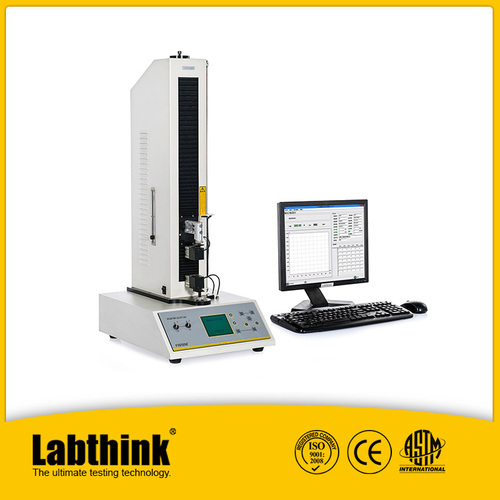
XLW(M) Bonding Force Tester
Principle
The pre-conditioned specimen is mounted between two grips, which move in relative direction during the test. The changes of force and displacement are separately recorded by the load cell fixed on the driven grip and embedded displacement transducer. The tensile strength, tear strength and elongation rate can be obtained by further calculation.
Specifications
| Load Cell Capacity | 100 N, 200 N, 500 N (one of them is available) |
| Accuracy | 1% FS |
| Test Speed | 50, 100, 150, 200, 250, 300, 500 mm/min |
| Number of Specimens | 1 |
| Specimen Width | 30 mm (Standard Grip)
50 mm (Optional Grip) |
| Clamping Way | Pneumatic Specimen Clamp |
| Stroke | 600 mm |
| Pressure of Gas Supply | 0.5 MPa~0.7 MPa (outside of supply scope) |
| Port Size | 4 mm PU Tubing |
| Instrument Dimension | 450 mm (L) x 580 mm (W) x 1100 mm (H) |
| Power Supply | AC 220V 50Hz |
| Net Weight | 60 kg |
Reliable Testing for Quality AssuranceDesigned for use in laboratories and manufacturing quality control, this Bonding Force Tester delivers dependable performance across key processes. Its digital load cell ensures consistent measurement of bonding forces, essential for verifying the integrity of electronic components. With its robust construction and precision calibration options, it supports exporters, manufacturers, and suppliers in maintaining superior product standards.
Versatile Design for Diverse EnvironmentsEngineered from stainless steel and ABS, the tester offers resilience and adaptability in varied laboratory and industrial settings. Operating efficiently within a temperature range of 10C to 40C, it provides accurate readings in multiple environmental conditions, making it a valuable tool for quality control professionals and researchers alike.
FAQ's of Bonding Force Tester:
Q: How is the Bonding Force Tester operated for testing electronic components?
A: To test electronic components, place the sample in the grip area of the tester. Select the appropriate calibration mode (manual or automatic), and initiate the force application using the digital controls. The load cell will digitally display the bonding force, allowing for precise analysis.
Q: What calibration options are available on the Bonding Force Tester?
A: The tester supports both manual and automatic calibration methods. Operators can choose the suitable mode depending on their workflow, facilitating accurate measurement and compliance with laboratory or manufacturing standards.
Q: When should I recalibrate the Bonding Force Tester?
A: It is recommended to recalibrate the tester periodically-ideally before critical testing sessions or after significant changes in testing conditions-to maintain accuracy and repeatability in results.
Q: Where can this tester be effectively used?
A: This Bonding Force Tester is ideal for laboratory settings, manufacturing quality control labs, export verification centers, and QA/QC departments of electronics manufacturers and suppliers in India.
Q: What is the benefit of using a digital load cell in this tester?
A: The digital load cell offers high precision measurements, fast response times, and clear digital readout. This reduces the risk of manual reading errors and enhances the accuracy of bonding force assessments.
Q: How does the material construction impact the tester's performance?
A: Constructed from stainless steel and ABS, the tester is both durable and resistant to corrosion, ensuring longevity and consistent performance even with frequent laboratory or manufacturing floor use.
Q: What is the process for routine maintenance of the Bonding Force Tester?
A: Routine maintenance involves regular cleaning of the mechanical parts, periodic calibration checks, and inspection of the digital load cell to ensure accurate performance is sustained over time.
 English
 Spanish
 French
 German
 Italian
 Chinese (Simplified)
 Japanese
 Korean
 Arabic
 Portuguese







 Send Inquiry


