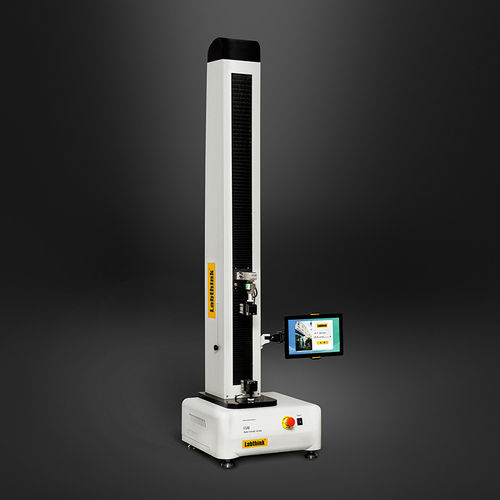
Product Description
Technical Specifications
|
Items
|
Specifications
|
|
Load Cell Capacity
|
200 N (30 N, 50 N and 100 N are optional)
|
|
Accuracy
|
1% of reading value
|
|
Test Speed
|
50, 100, 150, 200, 250, 300, 500 mm/min
|
|
Number of Specimens
|
1
|
|
Specimen Width
|
30 mm (Standard Grip)
|
|
50 mm (Optional Grip)
|
|
Sample Clamp
|
manual
|
|
Stroke
|
600 mm
|
|
Instrument Dimension
|
450 mm (L) x 580 mm (W) x 1100 mm (H)
|
|
Power Supply
|
AC 220V 50Hz
|
|
Net Weight
|
61 kg
|
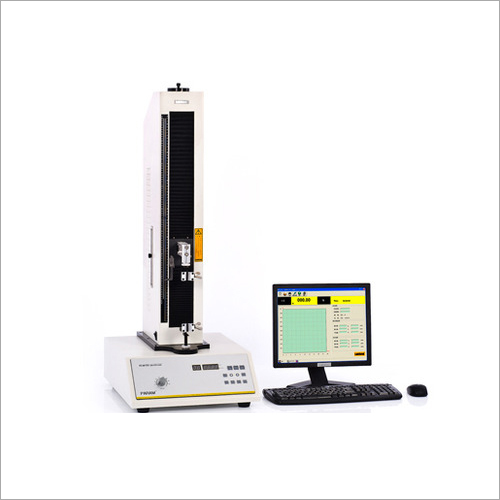
Precise and Versatile Testing CapabilityThis equipment accommodates a wide test range (0.01 N to 300 N) and supports both pneumatic and manual grips. With customizable specimen sizes and test speeds, it is ideal for diverse laboratory testing scenarios involving plastic films and other flexible substrates, ensuring accurate, reproducible results every time.
Advanced Data Management and CompatibilityThe system seamlessly interfaces via USB or RS232 ports and supports software compatibility with Windows operating systems (7/8/10). Users can easily export data in CSV, PDF, or Excel formats for efficient reporting and comprehensive record-keeping. The intuitive control and digital display simplify the analysis process.
Enhanced Safety and User ExperienceOperator safety is prioritized with features such as emergency stop, overload protection, and limit switches. The bench-mounted design and robust construction guarantee stable operation, while programmable setups and fast response times (2 ms) offer unmatched user convenience during routine or advanced testing tasks.
FAQs of Plastic Films Computerized Tensile Testing Equipment:
Q: How does the computerized tensile testing equipment ensure precise measurements?
A: The equipment utilizes microprocessor control, high-resolution load cells (0.001 N resolution), and a precision stepper motor to deliver highly accurate tensile test results (1% of reading). Its digital LCD screen and automated processes further enhance measurement reliability and repeatability.
Q: What are the main benefits of using this tensile testing equipment for plastic films?
A: The key benefits include rapid digital analysis, comprehensive data output (CSV, PDF, Excel), adjustable test speeds (10500 mm/min), and advanced safety features. Its ability to test up to five specimens in a batch increases efficiency in laboratories and quality control environments.
Q: Where is this tensile testing equipment typically used?
A: This equipment is designed for laboratory use by dealers, exporters, fabricators, manufacturers, producers, retailers, and suppliers of plastic films, primarily in quality control, research, and product development settings.
Q: When should a user select pneumatic versus manual grips?
A: Pneumatic grips offer convenience and uniform clamping pressure, making them ideal for regular, high-throughput testing or fragile specimens. Manual grips are suitable for specialized, low-frequency testing or when different grip forces are required for various material types.
Q: What is the process for exporting test data from the system?
A: Test data can be exported directly from the computer via USB or RS232 interface in multiple formats (CSV, PDF, Excel) using the included software, which is compatible with Windows 7, 8, and 10. This enables easy documentation and sharing of results.
Q: How does the emergency stop and overload protection mechanism work?
A: The emergency stop immediately halts all machine functions in hazardous situations. Overload protection automatically disengages the load application to prevent equipment damage if force exceeds the maximum rated capacity, ensuring both operator and equipment safety.
Q: What standard environmental conditions are required for optimal operation?
A: The equipment performs accurately within temperatures of 5C to 40C and humidity levels of 40% to 80% RH, using a standard AC 220V, 50 Hz power supply, making it suitable for most controlled laboratory environments.
 English
 Spanish
 French
 German
 Italian
 Chinese (Simplified)
 Japanese
 Korean
 Arabic
 Portuguese








 Send Inquiry



