Product Description
Features
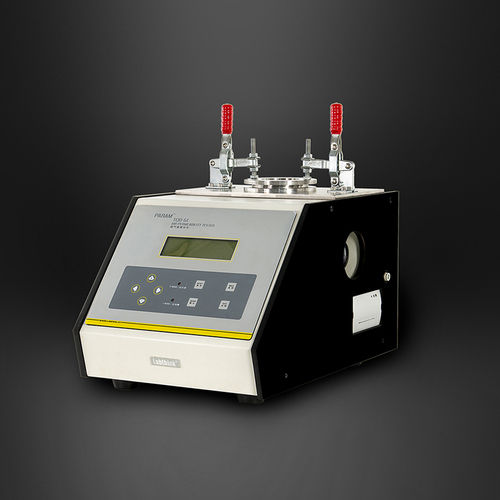
- This instrument is designed according to the standard requirements of global automakers.
- 2 test modes are available for customers: fix pressure difference to test flux and fix flux to test pressure difference
- High precision sensors of electronic airflow and air pressure to ensure the accuracy of test data
- The instrument is controlled by micro-computer, with LCD menu interface and PVC operation panel, which is convenient for customers to operate or view test data
- Equipped with micro-printer and standard RS232 port for easy connection with PC and data transfer
Test Principle
Method A
Providing a constant air flux going through the specimen vertically, the air permeability could be obtained by measuring the pressure difference.
Method B
Providing the constant pressure difference between two sides of the specimen, the air permeability could be obtained by measuring the air flux through specific area in the certain time.
Test Standards
TQD-G1 air permeability tester conforms to the multiple national and international standards: ISO 9237, ISO 4638, ISO 5636, GB/T 10655, GB/T 5453, GB/T 4689.22, GB/T 13764, ASTM D737, TAPPI T460, JIS P8117
Applications
TQD-G1 air permeability tester is applicable to the determination of:
| Basic Applications |
- Decorating Articles of Cars
Test the air permeability of car decorating materials, e.g. polyurethane, PVC, leather, textiles and nonwovens materials
|
- Elastic and Porous Polymer Materials
Test the air permeability of elastic and porous polymer materials, e.g. sponges
|
- Textiles
Test the air permeability of textiles, e.g. cloth and nonwovens
|
- Leather
Test the air permeability of leather
|
| Extended Applications |
- Paper
Test the air permeability of paper materials, e.g. daily removable tissue and toilet rolls
|
Technical Specifications
| Specifications |
TQD-G1 Air permeability tester |
| Test Range of Pressure |
0 1000 Pa |
| Test Range of Flux |
0 30 L/min |
| Specimen Size |
Method A: 52 mm x 52 mm
Method B12 mm D(diameter) I71 mm |
| Port Size |
I8 mm PU Tubing |
| Instrument Dimension |
502 mm (L) x 334 mm (W) x 298 mm (H) |
| Power Supply |
220VAC 50Hz / 120VAC 60Hz |
| Net Weight |
27 kg |
Configurations
- Standard Configurations
- Instrument, Micro-printer, Grips, Round Sample Cutter and Vacuum Pump from America
- Optional Parts
- Professional Software, Communication Cable and Customized Grips
- Note
- The gas supply port of the instrument is I8 mm PU tubing.
Comprehensive Laboratory TestingEngineered with laboratories in mind, this permeability tester provides highly reliable measurements for leather shoe uppers. Automatic stop, overload protection, and memory storage ensure safe and consistent operation even for extended testing cycles. Its quiet operation (noise level <60 dB) and compact size make it perfect for lab bench setups.
Advanced Measurement PrecisionThe tester utilizes a precision flow sensor with an impressive measuring range (0.1-1000 ml/min) and high resolution (0.01 ml/min). The device's rapid response time (2 s) and 2% accuracy deliver dependable results for material development, quality control, and compliance verification.
User-Friendly Digital ControlsFeaturing easy-to-navigate digital controls and a clear LED display, users can manage tests seamlessly. The tester supports both manual and semi-automatic operation, simplifies data tracking with memory storage, and allows direct connection through RS232 interface for data export or integration.
FAQ's of Lab Instrument for Measuring Leather Shoe Permeability:
Q: How does the Lab Permeability Tester measure water vapor permeability in leather shoe uppers?
A: The instrument uses a precision flow sensor and digital control to quantify the water vapor passing through leather shoe specimens during testing. Using provided accessories and a 500 ml water tank, the device measures permeability with a test speed of 60 cycles/min, providing real-time results on the digital LED display.
Q: What are the main benefits of using this instrument in a laboratory setting?
A: Key benefits include high measurement accuracy (2%), dual testing heads for parallel processing, memory storage for result tracking, and compliance with ISO 20344 and GB/T 20991 standards. Its semi-automatic operation, safety features, and factory calibration ensure ease of use and reliable repeatability.
Q: When should I calibrate the Lab Permeability Tester?
A: The instrument is factory calibrated and shipped with a calibration certificate. Regular calibration checks are advised yearly or whenever you observe unusual results or after major maintenance. Follow your lab's quality procedures for ongoing calibration validation.
Q: Where is this tester typically used, and can it be placed on regular lab benches?
A: Designed for laboratory environments, the tester is compact and operates quietly (noise level <60 dB). With its tabletop mounting type and dimensions (600 x 430 x 550 mm), it fits on most standard lab benches without special requirements.
Q: What is the process for preparing and running a permeability test with this equipment?
A: To run a test, prepare two leather specimens (60 x 60 mm each), insert them into the dual test heads, fill the 500 ml water tank, and connect the water supply pipe. Use the digital controls to set test parameters. The machine will operate at 60 cycles/min; results are displayed digitally and can be exported via RS232 interface.
Q: Which accessories are included with the equipment and what are they used for?
A: Included accessories are a measuring cylinder for water volume, a water supply pipe for easy filling, spare seals for maintenance, and a comprehensive calibration certificate to verify accuracy and compliance.
Q: What makes this Lab Permeability Tester suitable for compliance and exporting worldwide?
A: It meets international standards (ISO 20344, GB/T 20991), features digital calibration, robust powder-coated steel construction, and supports global requirements via the 220V AC power supply. These attributes support manufacturers, exporters, and suppliers aiming for consistent quality and regulatory adherence.
 English
 Spanish
 French
 German
 Italian
 Chinese (Simplified)
 Japanese
 Korean
 Arabic
 Portuguese










 Send Inquiry



