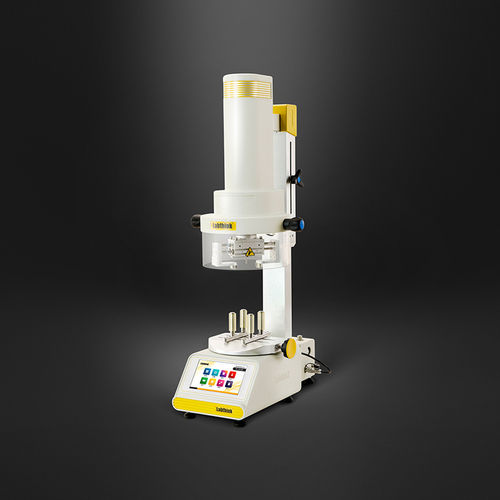
Product Description
Product FeaturesNote1
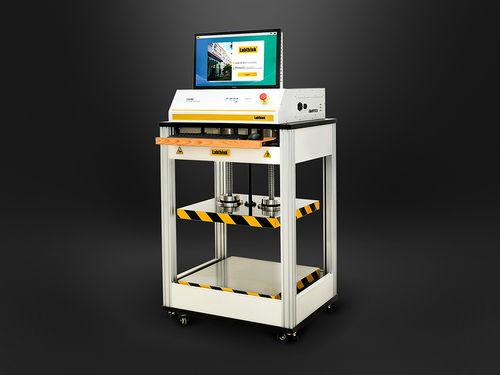
- Compact and integrated design and wide range power supply ?meet the testing requirements of various applications
- Supports crushing force test, stacking test A and stacking test B
- Dynamic digital display of test force, deformation and other test data
- High performance motor and dual precision ball screws support free adjustment of test speed
- Overload protection, maximum stroke protection and error alert for safe test operation
- High end embedded computer-controlled system integrates the instrument with software requires no external computer
- Labthinks unique data security design improves the reliability of data management and test operation
- Windows-like interfaces, keyboard and mouse, which are easy to use
- Four USB ports and dual net ports for data transmission
- The instrument conforms to the requirements of GMP (optional)
- Labthinks unique DataShiledTM System for data management and connecting with information system (optional)
Test StandardNote1
ASTM D642, ASTM D4169, TAPPI T804, ISO 12048, JIS Z0212, GB/T 16491, GB/T 4857.4, QB/T 1048-2004
ApplicationsNote1
| Basic Applications |
- Crushing Force Test of Cartons
Crushing force test of corrugated cartons and honeycomb boxes
|
- Stacking A Test of Cartons
Measuring the deformation of corrugated cartons and honeycomb boxes during stacking process
|
- Stacking B Test of Cartons
Determining whether the deformation of corrugated cartons and honeycomb boxes is qualified when specified force is applied for a certain period
|
| Extended Applications |
- Crushing Force Test of Hollow Containers
Crushing force test of hollow containers
|
- Stacking A Test of Hollow Containers
Measuring the deformation of hollow containers during stacking process
|
- Stacking B Test of Hollow Containers
Determining whether the deformation of hollow containers is qualified when specified force is applied for a certain period
|
Technical SpecificationsNote2
| Specifications |
C611M |
| Load Cell Capacity |
9KN (3 pcs) |
| Accuracy |
Indicated Value 1% (10% 100% of load cell capacity)
0.1% FS (0% 10% of load cell capacity) |
| Force Resolution |
1 N |
| Deformation Resolution |
0.1 mm |
| Test Speed |
0 200 mm/min (Any integer within the specified range) |
| Speed Accuracy |
Indicated Value 2% |
| Stroke |
450 mm |
| Specimen Height |
0 600 mm |
| Test Space |
0.8 m (L) 0.8 m (W) 0.61 m (H) |
| Instrument Dimension |
0.85 m (L) 1.01 m (W) 1.66 m (H) |
| Power Supply |
AC220V10% 50Hz / AC120V10% 60Hz |
| Net Weight |
245 kg |
Configurations
- Standard Configurations
- Instrument, Monitor, Mouse, Keyboard, 150mm Plate (1pcs)
- Optional Parts
- Auxiliary Metering Device, GMP System, DataShieldTM Note3
Note 1: The described test standard, applications and product features should be in line with Technical Specifications.
Note 2: The parameters in the table are measured by professional operators in Labthink laboratory under strictly controlled laboratory conditions.
Note 3: DataShieldTM provides safe and reliable data application support. Multiple Labthink instruments can share one single DataShieldTM system which can be configured as required.
Precision Testing with Advanced FeaturesEngineered for consistent and accurate compressive strength testing, this machine offers digital readout, automatic recording, and a versatile test range up to 1000 kN. The sturdy construction and protective features ensure long-term durability, while the sophisticated microprocessor system guarantees reliable measurements.
Safety and ComplianceIncorporating overload and over-travel protection, the unit meets IS 516, ASTM C39, and BS 1881 standards, and provides secure operation under varying laboratory conditions. Its anti-corrosive finish and high-grade steel platens add to the equipment's resilience and performance reliability.
Optimized for Laboratory and Industrial UseWith floor mounting capability and adaptability for various specimen sizes and types, the machine suits laboratories, manufacturers, and suppliers. The USB/Printer interface enables seamless data export, while easy operation maximizes efficiency for routine and complex testing alike.
FAQ's of Compression Strength Testing Machines:
Q: How does the compression strength testing machine measure and record test results?
A: The machine uses a microprocessor-based digital load indicating system to measure compression strength with 1% accuracy. Results are recorded automatically and stored internally for up to 100 tests, which can be exported via USB or printed directly.
Q: What types and sizes of specimens can be tested with this compression machine?
A: It is suitable for cubes (150 mm x 150 mm x 150 mm), cylinders (150 mm x 300 mm), and other construction materials such as bricks and blocks within its test width and clearance limits.
Q: When should I perform calibration and maintenance for optimal accuracy?
A: Calibration should be performed regularly, typically before major testing sessions or at intervals recommended in the operation manual. Routine maintenance ensures that the digital system and hydraulic mechanisms continue to operate precisely.
Q: Where is the machine ideally installed and used?
A: This compression strength tester is designed for laboratory and industrial environments. It is floor-mounted to provide stability during heavy-duty testing and fits facilities requiring compliance with international standards.
Q: What is the process for conducting a compression test on concrete specimens?
A: To test a specimen, place it between the steel platens, set the required parameters, and initiate the automatic or manual test mode. The hydraulic system applies force at the selected test speed, with load and result instantly displayed and stored.
Q: How do the safety features enhance operational security?
A: Overload and over-travel protection safeguards both users and the machine by stopping testing processes when forces exceed safe levels, reducing the risk of accidents and equipment damage.
Q: What are the main benefits of using this compression strength testing machine?
A: Users benefit from precise digital measurement, robust construction, compliance with key standards, easy operation, instant data recording, and reliable long-term performance, making it ideal for consistent quality control in material testing.
 English
 Spanish
 French
 German
 Italian
 Chinese (Simplified)
 Japanese
 Korean
 Arabic
 Portuguese










 Send Inquiry



