Product Description
Product FeaturesNote1
- The new ceramic oxygen sensor developed by Labthink has the characteristics of high precision and good repeatability.
- Ceramic oxygen sensor is non consumption type and has long service life.
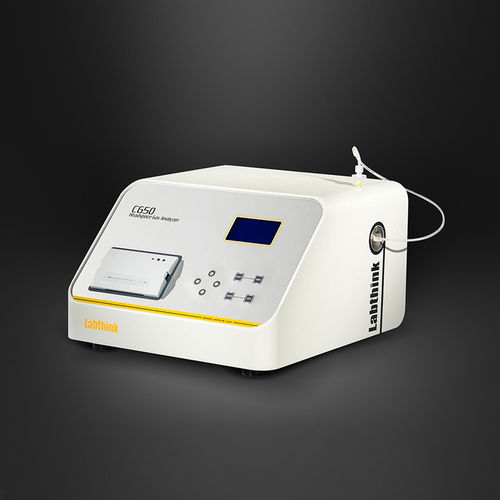
- PC material operation panel, menu interface, LCD display, easy to operate and view the results.
- The system supports Chinese and English bilingual operating environment to meet the needs of different language users.
- The microcomputer control system can analyze and process the test data and output the report.
- It is easy to print the test results at any time with the embedded micro printer.
- The system has built-in data storage to meet the needs of large amount of data storage.
- Portable, easy to use in laboratory or production sites.
- Equipped with RS232 interface and professional software, which convenient for computer connection and data import and export.
Test Principle
The gas in the sample is pumped into the sensor through the vacuum pump, and the sensor outputs the real time current and voltage signals of O2 and CO2 (optional) concentration of the gas in the sample. The instrument calculates the content of O2 and CO2 (optional) in the gas by obtaining the current and voltage signal output by the sensor. After reaching the requirements for ending the tests, the tests stop, and the instrument records the concentration of O2 and CO2 (optional) in the gas tested in the sample.
Test Applications
| Basic Applications |
- Pouches/bags
It is suitable for the determination of O2 and CO2 (optional) content in non negative pressure pouches, packaging bags of coffee, cheese, milk tea, milk powder, bread, soybean powder, modified atmosphere packaging, ready to eat food, medicine and other non negative pressure packaging bags.
|
- Packaging Containers
It is suitable for the determination of O2 and CO2 (optional) in canned coffee, canned milk powder, canned food, cheese, canned, Tetra Pak, beverage and other packaging containers
|
| Extended Applications |
- Ampoule Bottles
It is suitable for testing the concentration of O2 and CO2 (optional) in the head gas of ampoules
|
Technical SpecificationsNote2
| Items |
Parameters |
| Type of Gas Measured |
O2 (Standard) |
CO2 (optional) |
| Measuring Range |
0.2%21% |
2%100% |
| Measurement Accuracy |
0.2% |
2% |
| Sample Size |
5ml (standard atmospheric pressure) |
20ml (standard atmospheric pressure) |
| Dimensions |
350mm (L) 330mm(W) 200mm(H) |
| Power Supply |
220VAC 50Hz / 120VAC 60Hz |
| Net Weight |
5.5 kg |
Product Configuration Note 1
| Standard Configuration |
Mainframe, micro printer, sampling needle, filter and gasket |
| Options |
CO2 sensor, professional software, communication cable, hard packaging sampler, underwater sampling device |
Note 1: The product functions, reference standards and configuration information are subject to the specific notes in the "Technical Parameters".
Note 2: The parameters in the table are measured by professional operators in Labthink laboratory according to the requirements and conditions of relevant laboratory environmental standards.
Advanced Needle Gas Extraction for PrecisionThe C650H uses a needle sampling method to extract gas from the headspace of ampoules or small packages, ensuring minimal sample disturbance. This technique enables reliable analysis of the O2 and CO2 concentrations, crucial for pharmaceutical quality control and research environments.
User-Friendly Operation and AutomationDesigned with an LCD touchscreen and microcomputer control, the analyzer is easy to operate and semi-automatic for streamlined workflows. Automatic and manual calibration modes, along with rapid response times (under 10 seconds), make analyzing up to 20 samples a day fast and efficient.
Comprehensive Data Management and ComplianceThe C650H offers robust data management, storing over 50,000 test results and supporting report export in PDF or Excel format. Dual-language support and compliance with strict international standards (USP <1207>, ISO 11040-7) ensure suitability for global laboratory and pharmaceutical applications.
FAQs of Labthink C650H Headspace Gas Analyzer - Ampoule Headspace Gas Analysis Solution:
Q: How does the Labthink C650H Headspace Gas Analyzer operate?
A: The analyzer uses a needle extraction technique to sample gas directly from ampoule or small package headspaces. It then measures oxygen and carbon dioxide concentrations using electrochemical and NDIR sensors, delivering precise results displayed on its LCD touchscreen.
Q: What are the benefits of using the Labthink C650H for ampoule gas analysis?
A: The C650H offers fast, highly sensitive measurements with minimal sample disturbance. Its wide measuring range, high accuracy, and compliance with USP <1207> and ISO 11040-7 make it ideal for pharmaceutical quality assurance and research tasks.
Q: When should calibration be performed, and is it automatic?
A: Calibration can be carried out either automatically or manually, according to your laboratory protocols. Regular calibration ensures result accuracy and reliability during routine analyses.
Q: Where is the Labthink C650H Headspace Gas Analyzer typically used?
A: This instrument is primarily utilized in pharmaceutical laboratories, manufacturing quality control departments, and research institutions requiring precise headspace gas analysis of ampoules or small sealed packages.
Q: What is the typical process for conducting a test with this analyzer?
A: Users mount the sample ampoule, perform needle extraction for gas sampling, and then allow the device to analyze O2 and CO2 content. Results are available in less than 10 seconds and can be stored or exported as needed.
Q: How is data handled and reported by the analyzer?
A: The C650H can store more than 50,000 results internally. Data can easily be exported in PDF or Excel format through USB or RS232 interfaces, simplifying record keeping and regulatory audits.
Q: What specimen sizes and testing capacities does the C650H support?
A: It can accommodate ampoules with diameters ranging from 8 to 30 mm and can process up to 20 samples per day, analyzing one specimen at a time.
 English
 Spanish
 French
 German
 Italian
 Chinese (Simplified)
 Japanese
 Korean
 Arabic
 Portuguese










 Send Inquiry



