Product Description
Product FeaturesNote1
Multiple Test Modes & High Testing Efficiency
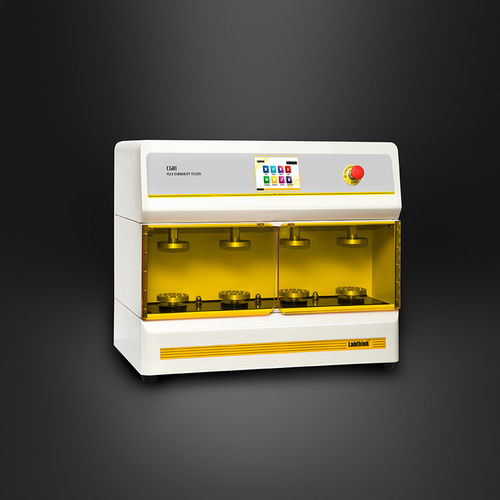
- Five standard test modes including condition A, B, C, D, E and one customized mode F, in which the user can set test cycles freely
- Four stations improve the testing efficiency
- Fast switch between long and short stroke
- Testing environment temperature and humidity are displayed in real time and automatically recorded for data comparison
Renowned Brand Servo Control System with Ultra-long Service Life and Ultra-low Failure Rate
- The instrument is controlled by servo motor, which provides more accurate displacement
- Dual protection for hardware and software as well as auto reset provides a safe operating environment for customers
New Patented Intelligent Touch Operating System
- Industrial grade touch screen, one-button operation, user-friendly interface, remote upgrade and maintenance
- Chinese and English languages can be selected
- Automatic data storage and power failure memory functions
- Historical data can be reviewed and printed easily
- Storage up to 1200 test records
- Multi-level user privilege management, log in with password
- Micro-printer for data exporting and data transfer (optional)
Test StandardNote1
ASTM F392
Applications
| Basic Applications |
- Flexible Films, Composite Films and Coating Films
Including plastic films, sheets and composite films e.g. composite films, aluminized films, aluminum plastic composite films, nylon films and coating films for food or drug packages
|
- Paper Materials
Test the flex durability of paper materials
|
Technical SpecificationsNote2
| Specification |
C681M Flex Durability Tester |
| Flex Frequency |
45 cpm |
| Test Mode |
Condition A (2700 cycles), Condition B (900 cycles),
Condition C (270 cycles), Condition D (20 cycles),
Condition E (20 cycles partial flex), Condition F (020000 cycles) |
| Tensile & Pressing Force |
300 N |
| Torque |
2 Nm |
| Specimen Thickness |
2.5mm (Sample clamps are needed for other thickness specimen) |
| Flex Angle |
440 / 400 |
| Horizontal Stroke |
155 mm / 80 mm |
| Number of Stations |
4 |
| Number of Specimens |
1 4Note3 |
| Specimen Size |
280 mm x 200 mm |
| Instrument Dimension |
760 mm (L) 410mm (W) 650mm (H) |
| Power Supply |
220VAC10% 50Hz / 120VAC10% 60Hz |
| Net Weight |
85 kg |
Configurations
- Standard Configurations
- Instrument, Adjustable Positioning Ring
- Optional Parts
- Micro-printer, Sample Cutter and Hose Clamp 64(91mm 114mm)
Note 1: The described test standard, applications and product features should be in line with Technical Specifications.
Note 2: The parameters in the table are measured by professional operators in Labthink laboratory under strictly controlled laboratory conditions.
Note 3: Multiple specimens share the tensile & pressing force and the torque.
Precision Flex Testing for Quality AssuranceThe ASTM D392 Flex Durability Tester serves as an essential tool for flex testing in quality control labs across industries like textiles, coated fabrics, and leather manufacturing. With an accurate digital LCD display, programmable timer, and high-resolution cycle counting, it delivers reliable data to evaluate product durability. Its robust construction and automatic safety features elevate test consistency while minimizing risks, making it indispensable for product development and compliance.
User-Friendly Design and Versatile OperationEngineered for convenience, the bench-top tester employs spring tension clamps and offers intuitive operation through both touch and push buttons. Its semi-automatic process, adjustable for various environmental conditions, enables effortless testing of up to six specimens simultaneously. With quick onsite installation and comprehensive support, users can experience seamless integration into laboratory workflows.
FAQ's of ASTM D392 Flex Durability Tester:
Q: How does the ASTM D392 Flex Durability Tester ensure safety during operation?
A: The tester is equipped with an overload protection system that automatically halts operation if excessive force is detected, thereby preventing damage to the equipment and ensuring operator safety during testing.
Q: What types of materials can be tested with this flex durability tester?
A: It is specifically designed for flex testing coated fabrics, leathers, and textiles, making it suitable for quality control and research in garment, upholstery, and industrial material sectors.
Q: When should the tester be used within a product development cycle?
A: This equipment is ideally utilized during both product development and final quality assurance stages, helping manufacturers verify material flexibility and durability before product launch or batch release.
Q: Where is the ASTM D392 Flex Durability Tester best installed for optimal use?
A: The compact, bench-top design allows the tester to be conveniently installed in laboratory or quality control environments, where stable ambient noise, humidity, and temperature ranges can be maintained for precise results.
Q: What is the process for clamping samples onto the machine?
A: Specimens are securely held using spring tension clamps. The setup supports up to six samples, each with a size of 70mm x 45mm, ensuring consistent sample placement throughout the test cycle.
Q: How can test data be exported from the flex tester?
A: Cycle count data can be conveniently exported via the machine's USB interface, facilitating efficient documentation and analysis for reporting and quality records.
Q: What are the main benefits of using this tester in a laboratory setting?
A: Laboratories benefit from the tester's high accuracy (1 cycle), low noise operation (<60 dB), minimal maintenance, automated features like sample counter and cycle export, and comprehensive support including onsite installation and training.
 English
 Spanish
 French
 German
 Italian
 Chinese (Simplified)
 Japanese
 Korean
 Arabic
 Portuguese










 Send Inquiry



