Product Description
Product FeaturesNote1
Multiple Test Modes & High Testing Efficiency
- Five standard test modes including condition A, B, C, D, E and one customized mode F, in which the user can set test cycles freely
- Four stations improve the testing efficiency
- Fast switch between long and short stroke
- Testing environment temperature and humidity are displayed in real time and automatically recorded for data comparison
Renowned Brand Servo Control System with Ultra-long Service Life and Ultra-low Failure Rate
- The instrument is controlled by servo motor, which provides more accurate displacement
- Dual protection for hardware and software as well as auto reset provides a safe operating environment for customers
New Patented Intelligent Touch Operating System
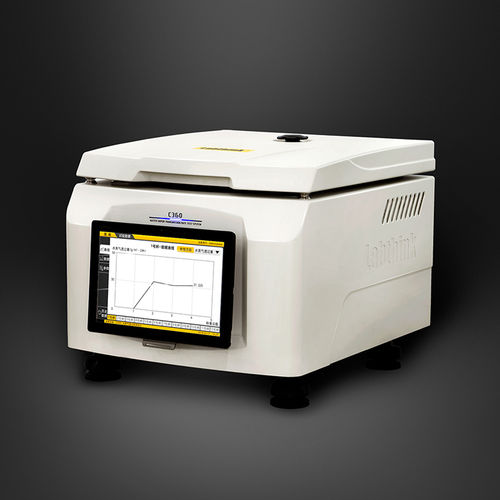
- Industrial grade touch screen, one-button operation, user-friendly interface, remote upgrade and maintenance
- Chinese and English languages can be selected
- Automatic data storage and power failure memory functions
- Historical data can be reviewed and printed easily
- Storage up to 1200 test records
- Multi-level user privilege management, log in with password
- Micro-printer for data exporting and data transfer (optional)
Test StandardNote1
ASTM F392
Applications
| Basic Applications |
- Flexible Films, Composite Films and Coating Films
Including plastic films, sheets and composite films e.g. composite films, aluminized films, aluminum plastic composite films, nylon films and coating films for food or drug packages
|
- Paper Materials
Test the flex durability of paper materials
|
Technical SpecificationsNote2
| Specification |
C681M Flex Durability Tester |
| Flex Frequency |
45 cpm |
| Test Mode |
Condition A (2700 cycles), Condition B (900 cycles),
Condition C (270 cycles), Condition D (20 cycles),
Condition E (20 cycles partial flex), Condition F (020000 cycles) |
| Tensile & Pressing Force |
300 N |
| Torque |
2 Nm |
| Specimen Thickness |
2.5mm (Sample clamps are needed for other thickness specimen) |
| Flex Angle |
440 / 400 |
| Horizontal Stroke |
155 mm / 80 mm |
| Number of Stations |
4 |
| Number of Specimens |
1 4Note3 |
| Specimen Size |
280 mm x 200 mm |
| Instrument Dimension |
760 mm (L) 410mm (W) 650mm (H) |
| Power Supply |
220VAC10% 50Hz / 120VAC10% 60Hz |
| Net Weight |
85 kg |
Configurations
- Standard Configurations
- Instrument, Adjustable Positioning Ring
- Optional Parts
- Micro-printer, Sample Cutter and Hose Clamp 64(91mm 114mm)
Note 1: The described test standard, applications and product features should be in line with Technical Specifications.
Note 2: The parameters in the table are measured by professional operators in Labthink laboratory under strictly controlled laboratory conditions.
Note 3: Multiple specimens share the tensile & pressing force and the torque.
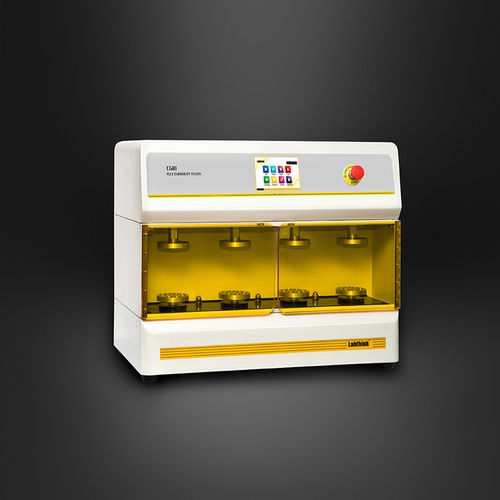
Reliable Flexing Tests for APC FilmsThis instrument is engineered to deliver accurate and repeatable stressing of Aluminum Plastic Composite films, tailored for quality control and research applications. Its robust frame, adjustable test parameters, and user-friendly digital controls enable precise analysis of material durability and flexibility. The compact, bench-top design fits any laboratory setting, promoting efficiency and space saving.
Simple Operation and Enhanced SafetyOperators benefit from straightforward controls, a clear digital display, and automatic cycle counting. Safety is prioritized with an emergency stop, a safety shield, and auto-stop functionality on door opening, reducing risk during testing. The included accessories such as specimen holders and a user manual streamline setup and daily use.
FAQ's of Flexing Instrument for Stressing Aluminum Plastic Composite (APC) Film:
Q: How does the Flexing Instrument test APC film durability?
A: The instrument uses a programmable pneumatic drive to flex Aluminum Plastic Composite films repeatedly at adjustable speeds and stroke settings. This simulates real-world stresses, allowing precise measurement of material endurance up to 999,999 cycles.
Q: What is the recommended operating environment for this equipment?
A: It is designed for use in indoor laboratory environments that are dust-free, with humidity between 45% and 85%RH and temperature ranging from 15C to 40C.
Q: When should I use the dual-station capacity?
A: Choosing the dual-station option allows simultaneous testing of two specimens, ideal for comparative studies or increasing test throughput in busy laboratories.
Q: Where is this instrument commonly used?
A: The flexing instrument is primarily employed in research institutes, quality control departments, and production laboratories, especially those testing composite films or similar flexible materials.
Q: What is the process for starting a test?
A: Install the specimen using the provided holders, configure the test parameters via the microcomputer digital control, close the safety shield, and start the test. The device will automatically count cycles and stop as programmed or in an emergency.
Q: How can this instrument benefit laboratory testing?
A: It ensures high accuracy and repeatability in flexing tests, streamlines operation with automated features, and enhances lab safety, ultimately speeding up material qualification and quality assurance.
Q: What accessories come with the Flexing Instrument?
A: The equipment includes a user manual, a set of specimen holders, and a power cord, ensuring users have all essentials for immediate setup and operation.
 English
 Spanish
 French
 German
 Italian
 Chinese (Simplified)
 Japanese
 Korean
 Arabic
 Portuguese










 Send Inquiry



