Product Description
Product Features Notes1
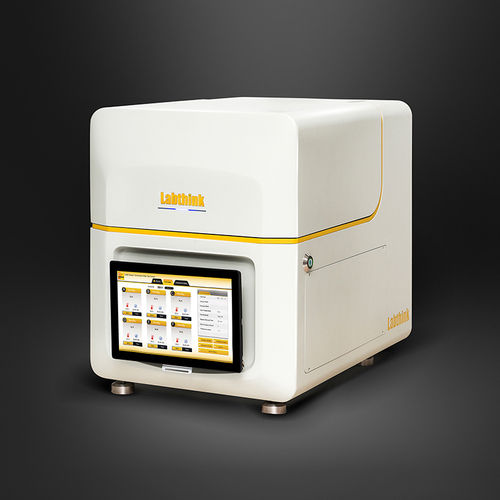
- Menu interface, color touch screen operation, convenient and fast to set test parameters.
- Two test modes A and B are provided, and the test status is automatically judged.
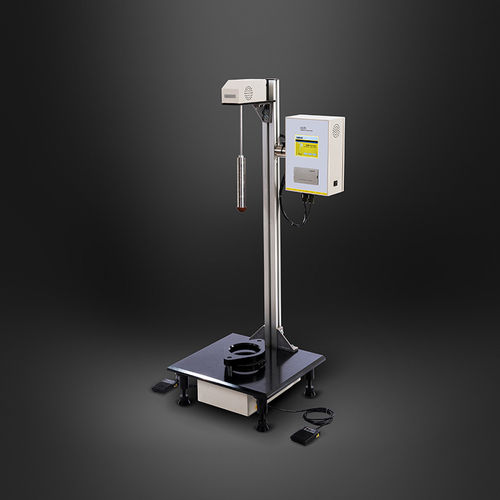
- The falling dart adopts the principle of electromagnetic hanging, which can release automatically, effectively avoiding the system error caused by human factors.
- Pneumatic sample clamping, manual and pedal dual start mode, built-in observation lamp unique design; convenient, fast and accurate operation.
- Professional computer software supports the functions of multi unit display of test results, graphic display of test process, output and print function, showing the results clearly and intuitively.
- Micro printer and standard RS232 interface make the tester convenient for the external connection and data transmission between the system and the computer.
Testing Principle
At the beginning of the test, select the test method as the first procedure, estimate an initial mass and 3m value, and conduct the test. If the first sample is damaged, the weight 3m shall be used to reduce the falling mass; if the first sample is not broken, the weight 3m shall be used to increase the falling mass for test in turn. In short, the use of weights to reduce or increase the falling mass depends on whether the previous sample is damaged. After 20 samples are tested, the total number of damaged samples is calculated. If n is equal to 10, the test is completed; if n is less than 10, continue the test after supplementing samples until n is equal to 10; if n is greater than 10, continue testing after supplementing samples until the total number of undamaged samples is equal to 10. Finally, the system automatically calculates the impact results.
Reference Standard Note 1
ISO 7765-1-1988, ASTM D1709, GB/T 9639.1-2008, JIS K7124-1
Test Applications
| Basic Applications |
- Film & Sheet
It is suitable for testing the impact resistance of plastic film, sheet and composite film with thickness less than 1 mm. Such as PE film, wrapping film, PET sheet, food packaging bags of various structures, heavy packaging bags, etc
|
- Aluminum Foil, Aluminum Plastic Composite Film
It is suitable for testing the impact resistance of aluminum foil and aluminum plastic composite film
|
- Paper and Paperboard Test
It is suitable for testing the impact resistance of paper and paperboard
|
| Extended Applications |
- Drop Ball Impact Test
It is suitable for the drop ball impact test of the sample. The sample is clamped on the falling ball impact test fixture, and the falling ball of certain quality is selected to impact the sample from a certain height. The damage of the sample is checked and the impact resistance of the sample is judged
|
- Shoulder Lining Impact Test
It is suitable for the falling dart impact test of shoulder lining. Put the shoulder lining sample on the special test fixture, select a certain quality dart head to impact the shoulder lining sample from a certain height, and judge the impact resistance of the sample according to the sample damage
|
Technical Parameters Note 2
| Items |
Parameters |
| Measuring Method |
Method A, method B(optional) |
| Test Scope |
Method A: 50-2000g
Method B: 300-2000g |
| Weight Accuracy |
+0.5% |
| Sample Clamping |
Pneumatic |
| Air Source Pressure |
0.6 MPa (Prepared by user) |
| Air Connection |
I 8 mm polyurethane pipe |
| Sample Size |
>150 mm x 150 mm |
| Power Supply |
220VAC 50Hz / 120VAC 60Hz |
| Net Weight |
70 kg |
| Dimensions |
Amethod:500 mm (L) 450 mm (W) 1320 mm (H) |
| Method B: 500 mm (L) 450 mm (W) 2160 mm (H) |
Product Configuration Note 1
| Standard Configuration |
A method configuration, touch screen, micro printer |
| Options |
Method B configuration, professional software and communication cable |
| Remarks |
The air source interface of the machine is I 8 mm polyurethane pipe; the air source is provided by the user |
Note 1: The product functions, reference standards and configuration information are subject to the specific marks in the "technical indicators".
Note 2: The parameters in the table are measured by professional operators in Labthink laboratory according to the requirements and conditions of relevant laboratory environmental standards.
Reliable Impact Resistance TestingOur Drop Ball Impact Strength Tester provides precise, repeatable assessments of material durability, facilitating compliance with recognized standards such as ASTM D1709 and IS 2508. This device is essential for quality assurance in industries dealing with glass, plastic, and similar materials.
Robust and User-Friendly EngineeringConstructed with durability in mind, this tester boasts a powder-coated base, stainless steel supports, and an intuitive control interface. The adjustable drop height (up to 2 meters) and safety shield ensure both versatility and operator protection during every test.
Versatile Laboratory and Industrial ApplicationsDesigned for use in indoor laboratory settings as well as demanding industrial environments, the drop ball tester accommodates specimens up to 200 x 200 mm, providing flexible solutions for manufacturers, suppliers, and exporters across various sectors.
FAQ's of Drop Ball Impact Strength Testers:
Q: How does the Drop Ball Impact Strength Tester operate in a laboratory setting?
A: The tester allows users to secure a single specimen using adjustable clamps, set the desired drop height (up to 2 meters), and release a hardened steel ball either electromagnetically or manually. The impact strength is then measured instantly and displayed digitally with a high degree of accuracy.
Q: What types of materials can be tested using this equipment?
A: This drop ball tester is designed for testing the impact resistance of glass, plastic, and other similar materials. Its versatility supports quality control and research in both industrial and laboratory environments.
Q: When should the Drop Ball Impact Strength Tester be used?
A: It should be used during quality control checks, new product testing, or material research phases to verify that materials meet standardized impact resistance requirements such as ASTM D1709 and IS 2508.
Q: Where should the tester be installed for optimal performance?
A: The tester is intended for use in indoor laboratory environments or industrial quality control areas, operating reliably in temperatures ranging from 10C to 40C and humidity levels up to 85% RH.
Q: What is the process for conducting a test with this equipment?
A: To conduct a test, mount the specimen using adjustable clamps, set the drop height and ball diameter as per the test standard, select the release mechanism, and trigger the drop. The machine instantly measures and displays the impact result.
Q: How does digital control enhance the usage of this tester?
A: Digital control provides precise drop height selection, accurate data collection, and an easy-to-read digital display, improving repeatability and reducing operator error during testing.
Q: What are the key benefits of using this Drop Ball Impact Strength Tester?
A: Benefits include compliance with major standards, reliability in operation, high measurement accuracy, user safety through a dedicated shield and safety lock, and easy adaptation for various specimen sizes and materials.
 English
 Spanish
 French
 German
 Italian
 Chinese (Simplified)
 Japanese
 Korean
 Arabic
 Portuguese










 Send Inquiry



