Product Description
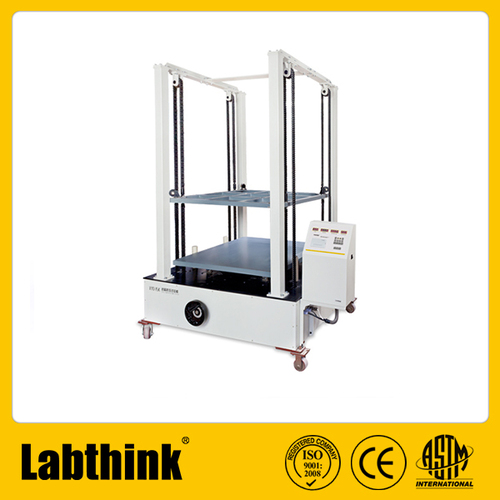
XYD-15K Compression Testing Instrument can be used to measure the compressive resistance, deformation and stacking capability of cartons, beehive crates, plastic tanks (for edible oil and mineral water), paper tanks, paper cases, IBC tanks and other packages.
Compression Testing Instrument conforms to various national and international standards:
ISO 12048, ASTM D642, ASTM D4169,TAPPI T804, JIS Z0212, GB/T 16491, GB/T 4857.4
Application:
| Basic Applications | Deformation under Defined Load
Test deformation under defined load of various corrugated cartons and beehive crates |
| Load under Defined Deformation
Test load under defined deformation of various corrugated cartons and beehive crates |
| Maximum Load
Test the maximum load of various corrugated cartons and beehive crates |
| Stack Test
Stack test of various corrugated cartons and beehive crates |
Features:
- High Standard Box Compression Tester for Sale is controlled by micro-computer with menu interface, PVC operation panel and the testing process is automatic
- 4 testing modes: deformation under defined load, load under defined deformation, maximum load and stack tests
- Dynamic digital-display of the test number, specimen deformation, real-time load and initial load
- Single-phase power and direct-current drive guarantee the adjustability, accuracy and stability of test speed
- Overload protection, maximum stroke protection and error alert for safe test operation
- Light-weight design, suitable for various floor loads
- Equipped with micro printer which is convenient for the printing of test data
Technical Specification
| Load Cell Capacity | 15 KN or 45 KN (Optional) |
| Accuracy | 1% FS |
| Force Resolution | 1 daN |
| Deformation Resolution | 0.1 mm |
| Test Speed | 5 mm/min, 10 mm/min, 12.7 mm/min |
| Test Space | 1 m (L) x 1 m (W) x 1.3 m (H) |
| Power Supply | AC 220V 50Hz |
| Instrument Dimension | 1.2 m (L) x 1.5 m (W) x 2.3 m (H) |
| Net Weight | 800 kg |
Versatile Applications Across IndustriesOur compression testing instruments are employed in sectors like construction, engineering, and quality control. They are designed to analyze material strength, helping manufacturers and engineers make informed decisions about material selection and safety compliance.
Quality Assurance and ComplianceEvery instrument undergoes rigorous quality checks, ensuring precise results for each test. Our comprehensive supply chain, including dealer, exporter, and manufacturer roles in China, guarantees that customers receive authentic and efficiently calibrated equipment.
FAQs of Compression Testing Instrument:
Q: How is a compression testing instrument used in practical applications?
A: A compression testing instrument is employed by placing a sample material between two plates and applying force until it deforms or breaks. This process measures the materials resistance to being compressed, providing vital data for safety and engineering analysis.
Q: What materials can be tested with this compression testing equipment?
A: The instrument is suitable for testing a wide range of materials, such as concrete, metals, ceramics, and plastics. Its versatility makes it an invaluable tool in quality control laboratories, research institutes, and industrial settings.
Q: When should a compression test be conducted?
A: Compression testing should be performed during material development, product quality assessment, and before construction or fabrication projects. Regular testing ensures that the materials meet required safety and regulatory standards.
Q: Where is this compression testing instrument commonly used?
A: This equipment is frequently used in laboratories, construction sites, research centers, and manufacturing facilities, particularly where material strength and structural integrity are crucial.
Q: What are the key benefits of using a compression testing instrument?
A: Key benefits include ensuring material safety, preventing structural failures, and complying with industry standards. Accurate testing supports better quality control and confidence in material performance.
Q: What is the typical process of conducting a compression test with this instrument?
A: The process generally involves preparing a material specimen, positioning it correctly within the instrument, and gradually applying loading force. The machine records the force at which the material yields or fractures, providing measurable results for analysis.
 English
 Spanish
 French
 German
 Italian
 Chinese (Simplified)
 Japanese
 Korean
 Arabic
 Portuguese









 Send Inquiry


